
2.5D Topographies – 2 Cutting-Edge Solutions!

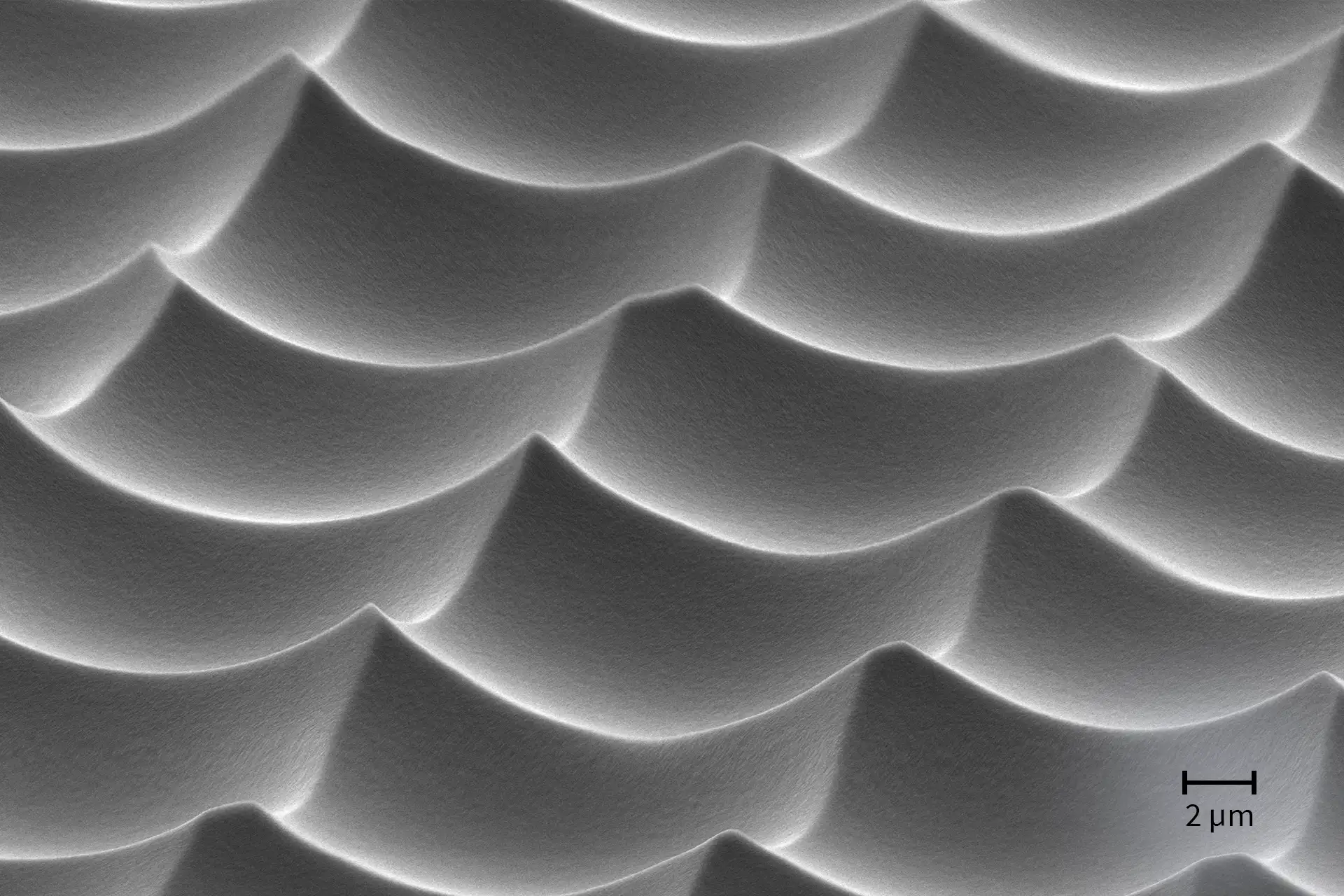
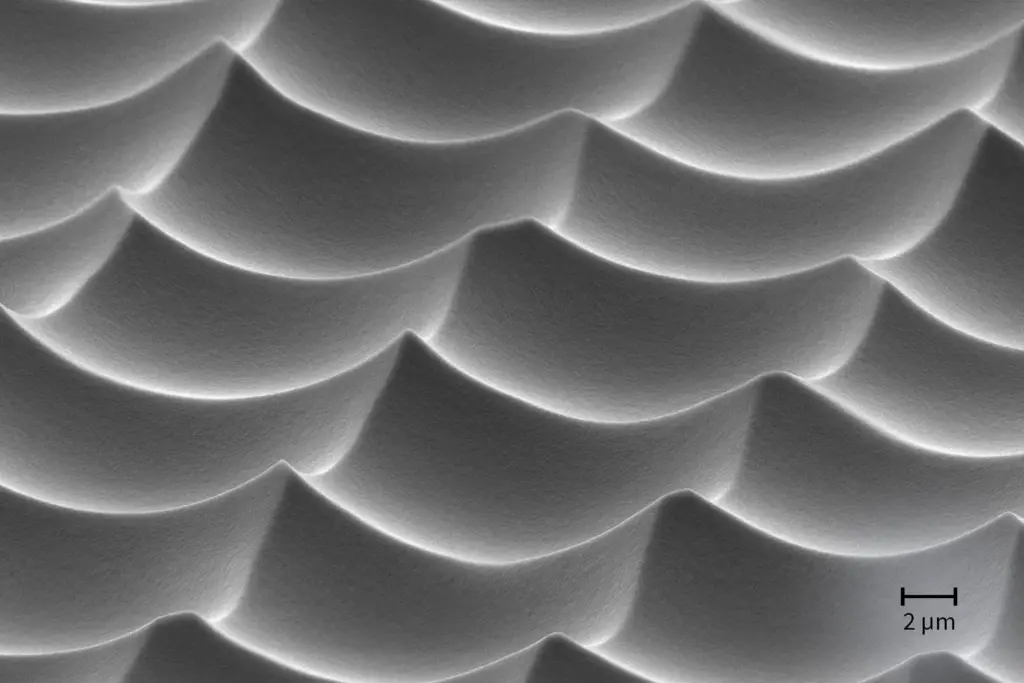
Irregular concave lens array patterned with Heidelberg Instruments grayscale lithography on a DWL 66+

Advancing Excellence in Microfabrication: Fabrication of 2.5D Topographies with Maskless Grayscale Lithography or Two-Photon Polymerization (TPP)

What looks like ocean waves or river pebbles is an excellent example of the grayscale capabilities of Heidelberg Instruments tools. The irregular microlens arrays seen here might be used for light diffusion, modulating a light source exactly how it is intended by the user. They perfectly illustrate the design freedom that is at your disposal with grayscale exposure. Complex designs like these are patterned with high accuracy, high throughput, 100% fill factor, and excellent surface quality.

The structures have been patterned with our DWL 66+ high-resolution direct-write pattern generator:

While our Two-Photon Polymerization tool MPO 100 unlocks genuine third-dimensional possibilities, enabling the creation of overhanging or suspended structures, it also excels in the realm of 2.5D. It proves outstanding for achieving ultra-sharp angles and delivers incredible resolution, reaching a minimum structure size of 100 nm.

The structures shown below have been fabricated with MPO 100:

Did you know? To generate 2.5D topographies, we are not limited to one technology – both Maskless Grayscale Lithography (with the DWL series or the µMLA) and Two-Photon Polymerization (with the MPO 100) are suitable options.

Contact us with your specific application and we will recommend the optimal tool for your requirements by comparing various technologies!

Stay updated and subscribe to our news:

Share:

Related Posts

Prof. Dr. Andrea Vezzoli, Royal Society University Research Fellow and Professor of Physical Chemistry at the University of Liverpool.

Where Chemistry Meets Nanofabrication: Building Molecular Devices

Explore how molecular electronics research combines chemistry, thermal scanning probe lithography and maskless laser lithography. Discover how modifying resist chemistry helped overcome a fabrication bottleneck and integrate µMLA and NanoFrazor technologies in an interview with Andrea Vezzoli of the University of Liverpool.

OLED Display Technology and Generations in Display Manufacturing

Halftone Photomasks for Next-Generation Displays

How are massive glass substrates patterned with the precision required for next-generation displays? Explore how halftone photomasks create multi-level resist profiles in a single exposure, simplify TFT fabrication, and why large-area mask manufacturing demands exceptional overlay, uniformity, and thermal stability.

Scroll to Top